Microwave Digestion System Vessels
MARSXpress Vessels

Microwave Digestion System Vessels
MARSXpress Vessels
High-throughput, easy to assemble vessels for routine sample prep.
Summary
The MARSXpress™ vessel family offers simple assembly, easy operation, and reliable digestion performance across various sample types. As the industry’s leading high-throughput solution, MARSXpress vessels support efficient, high-capacity sample preparation in laboratories worldwide. Their simple three-part design allows for quick assembly and intuitive operation, while also ensuring safe and rapid high temperatures.Widely recognized as the preferred choice for environmental digestions, including US EPA methods (3015a, 3051a and 3052), European norms, AOAC methods, ISO standards, ASTM methods, CPSC testing, and more, MARSXpress vessels have a batch capacity of up to 40 positions, making them an ideal solution for laboratories requiring maximum throughput without compromising reliability.
Key Benefits
- Digest up to 40 samples in a single batch
- Easy vessel assembly
- Simple to clean
- Ideal for routine digestion applications
- Digest up to 40 samples in a single batch
- Easy vessel assembly
- Simple to clean
- Ideal for routine digestion applications
Which MARSXpress vessel set is right for you?
MARSXpress

Vessel Capacity
40
Volume (mL)
20, 55, or 75
Max Temp
210 °C
Compatible Instruments
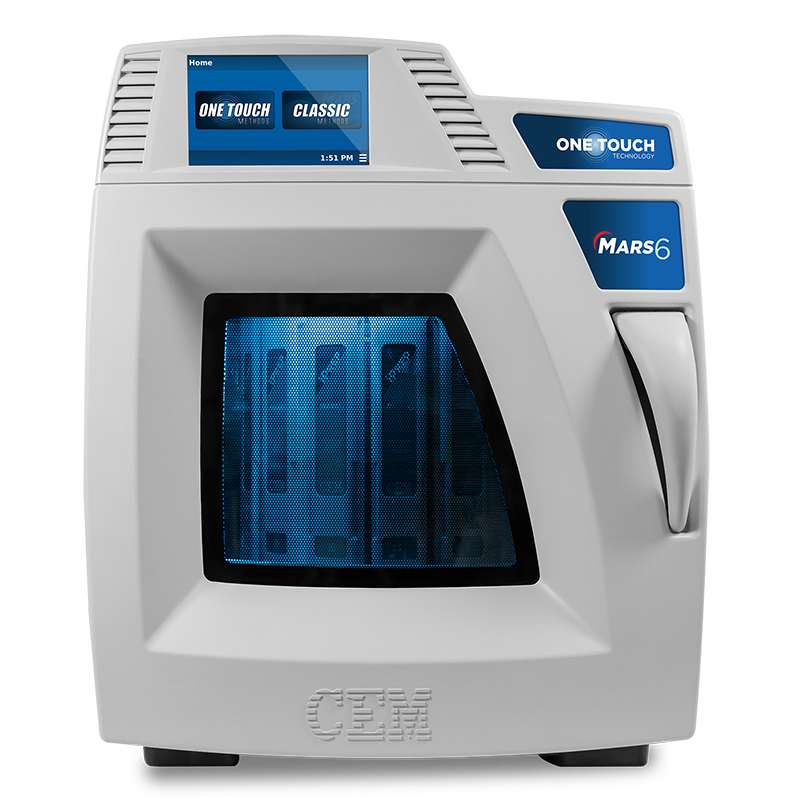
MARS 6
MARSXpress 2.0
MARSXpress Plus

Vessel Capacity
24
Volume (mL)
110
Max Temp
210 °C
Compatible Instruments
MARS 6
MARSXpress 2.0
MARSXpress Max

Vessel Capacity
24
Volume (mL)
130
Max Temp
220 °C
Compatible Instruments
MARSXpress 2.0

Simple construction
Less to assemble. Less to clean.
The vessels consist of only three parts; no springs or membranes required. The streamlined design simplifies both assembly and cleaning.Insert the plug into the liner, tighten the cap, and add to the turntable; assembly could not be easier.
Typical Uses
EPA Methods
EPA Method 3051aEPA Method 3052
EPA Method 3015a
EPA Method 1311
AOAC Methods
AOAC 2024.02AOAC 2021.03
AOAC 2017.02
AOAC 2015.01
AOAC 2013.06
AOAC 2011.19
AOAC 2006.03
AOAC 999.10
ASTM Methods
ASTM E1645-01ASTM D5513-99
ASTM D4309-96
ASTM E1741-00
ASTM D3171-154
ISO Methods
ISO 16729: 2013ISO 54321:2021
ISO 14127:2024
USCPSC Methods
CPSC-CH-E1001-08.1CPSC-CH-E1002-08.1
CPSC-CH-E1003-09
US Pharmacopeia Methods
USP <2232>USP <232> /<233>
View Typical Methods
Vessel Comparison
Find the right vessel for your application.
MARSXpress Vessels

Summary
The MARSXpress vessels are available in 20 mL, 55 mL, and 75 mL and are offered in both TFM and PFA materials, ensuring excellent chemical resistance and long-term reliability. Mix and match samples or load 40 of the same sample type within a turntable to get the most flexibility from this high-throughput option.While EPA methods are built around 24 samples per batch, the MARSXpress turntable allows up to 40 vessels per run, enabling increased laboratory throughput when suitable.
Applications
As examples of common sample types for the MARSXpress vessels, the following materials can be digested at the listed maximum sizes.For questions about your particular sample, reach out to our applications team at info@cem.com.
| Sample Type | Maximum Sample Size |
|---|---|
| Animal and Fish Tissue | 0.5 gram |
| Environmental Solids | 0.5 gram |
| Feeds and Fertilizer | 0.5 gram |
| Filter (paper and cellulose) | 0.25 gram |
| Foods | 0.5 gram (dry weight) |
| Infant or Geriatric Formula | 0.5 gram (dry weight) |
| Nutraceutical | 0.5 gram |
| Nylon | 0.25 gram |
| Pharmaceutical | 0.25 gram |
| Plant Tissue | 0.5 gram |
| Polypropylene | 0.1 gram |
| Waste Oil | 0.1 gram |
MARSXpress Plus Vessels

Summary
As the larger volume member of the MARSXpress line, the MARSXpress Plus vessels accommodate larger sample sizes, while still fully satisfying the requirements of US EPA, European Norms, AOAC, ASTM methods, and other regulatory methods.Up to 24 vessels can be loaded into the turntable, with the flexibility to mix and match samples to maximize both capacity and throughput. The larger 110 mL volume is able to achieve high digestion temperatures, yet still maintain the simple userfriendly assembly that defines the MARSXpress platform, making the MARSXpress Plus vessels a powerful option for laboratories requiring robust, operator-friendly digestion performance.
Applications
As examples of common sample types for the MARSXpress vessels, the following materials can be digested at the listed maximum sizes.For questions about your particular sample, reach out to our applications team at info@cem.com.
| Sample Type | Maximum Sample Size |
|---|---|
| Animal and Fish Tissue | 0.5 gram |
| Environmental Solids | 0.5 gram |
| Feeds and Fertilizer | 0.5 gram |
| Filter (paper and cellulose) | 0.25 gram |
| Foods | 0.5 gram (dry weight) |
| Infant or Geriatric Formula | 0.5 gram (dry weight) |
| Nutraceutical | 0.5 gram |
| Nylon | 0.25 gram |
| Pharmaceutical | 0.25 gram |
| Plant Tissue | 0.5 gram |
| Polypropylene | 0.25 gram |
| Waste Oil | 0.1 gram |
MARSXpress Max Vessels


Get Vessels for
MARSXpress 2.0
Summary
Need to digest even larger sample sizes? The MARSXpress Max answers. With an industry-leading 130 mL capacity, while maintaining the same simple operation design as the trusted MARSXpress vessels, the MARSXpress Max combines volume, convenience, and performance.Load up to 24 vessels in the turntable in the MARSXpress 2.0 system and digest up to 1 g of sample with ease and efficiency.
Applications
As examples of common sample types for the MARSXpress vessels, the following materials can be digested at the listed maximum sizes.For questions about your particular sample, reach out to our applications team at info@cem.com.
| Sample Type | Maximum Sample Size |
|---|---|
| Animal and Fish Tissue | 1 gram |
| Environmental Solids | 1 gram |
| Feeds and Fertilizer | 0.75 gram |
| Filter (paper and cellulose) | 0.5 gram |
| Foods | 1 gram (dry weight) |
| Infant or Geriatric Formula | 1 gram (dry weight) |
| Nutraceutical | 1 gram |
| Nylon | 0.25 gram |
| Pharmaceutical | 0.25 gram |
| Plant Tissue | 1 gram |
| Polypropylene | 0.25 gram |
| Waste Oil | 0.1 gram |